
Let’s start with the uncomfortable truth: French Bulldogs can be absolute nightmares to potty train.
They’re intelligent—genuinely, properly clever—but they’re also magnificently stubborn. They understand exactly what you want them to do. They simply have to be convinced it’s also what they want to do. It’s less like training a dog and more like negotiating with a tiny, snorting union representative who has very strong opinions about where one should wee.
We’ve potty trained two French Bulldogs. Buster, our distinguished gentleman, got the concept in about two weeks and has had maybe three accidents in his entire life (all strategically placed on our least favourite rug, because he’s got standards). Jago came to us at six months, pre-trained by his breeder (we got incredibly lucky), but he still had opinions about toilet locations that needed… negotiating.
The first week with Buster was intensive — schedule, routine, more trips outside than I thought physically possible. But he understood. He cooperated. He’s a swot.
Jago required less training and more management. He knew what to do. He simply had to be convinced that our garden was an acceptable toilet location. This took treats, patience, and one memorable incident involving a Croc that we’re still processing.
Here’s everything we learned, including the mistakes we made so you don’t have to.
Are French Bulldogs Hard to Potty Train?
Short answer: Yes, but not impossible.
Long answer: It depends on your Frenchie’s personality, your consistency, the alignment of the planets, and whether Mercury is in retrograde (I’m joking, but only slightly).
Why French Bulldogs can be challenging:
Stubbornness: They were bred to be companion dogs with opinions. Strong opinions. Opinions they’re willing to defend with passive resistance.
Bladder size: They’re small dogs with small bladders. An 8-week-old Frenchie puppy can hold it for about 2-3 hours maximum. Expecting more is just setting everyone up for disappointment.
Intelligence: This sounds like it should help, but clever dogs can be sneaky. Jago learned to fake needing the toilet to get extra garden time. We fell for it for weeks.
Distractibility: Frenchies have the attention span of a goldfish at a rave. They go outside to wee, see a leaf, forget why they’re outside, come back in, remember they need a wee, and helpfully do it on the kitchen floor.
Communication: They’re not big barkers. Some Frenchies never learn to signal they need out. You have to learn to read the subtle signs, which with a puppy mostly amounts to “suddenly very interested in corners.”
The good news: Once they get it, they really get it. A properly potty-trained Frenchie is reliable. They just require patience, consistency, and a sense of humour to get there.
Before You Start: What You Actually Need
You cannot potty train a French Bulldog on vibes alone. You need supplies, a plan, and possibly wine (for you, not the dog).
Essential Equipment:
1. A crate (properly sized—see the crate section in our French Bulldog puppy checklist)
- Not a prison, a den
- Big enough to stand and turn around, not so big they can wee in one corner and sleep in another
- Buster’s crate: his fortress of solitude
- Jago’s crate: a personal insult he complained about for six months
2. Enzyme cleaner (the most important thing you’ll buy)

Dirtbusters Pet Pro Urine & Odour Destroyer
We may earn a commission from purchases (at no extra cost to you)
3. Training treats (tiny, high-value, delivered with Oscar-worthy enthusiasm)
- We use small pieces of chicken, cheese, or fancy training treats
- Reward size: smaller than your pinky nail
- You’ll use approximately 847 treats in the first week
- Jago’s motto: “Will potty train for cheese”
4. Puppy pads (controversial, but useful for flats/apartments)

Pet's Hub Training Pads (50 Pack)
We may earn a commission from purchases (at no extra cost to you)
5. A schedule (written down, on your phone, tattooed on your arm—whatever works)
6. Patience (not sold in shops, unfortunately)
Nice to Have:
- A bell for the door (if you want to teach door signalling)
- Outdoor shoes you don’t mind wearing 47 times a day
- A waterproof jacket (British weather, need I say more?)
- Realistic expectations
- A second person to share the 3am toilet trips (highly recommended)
The Method: Step-by-Step Schedule
Right, here’s the actual plan. This is what worked for us (eventually).
Week 1-2: Every Hour, Outside, Mass Celebration
This is the intense phase. You will feel like you live outside. Your neighbours will wonder if you’ve moved to the garden. Accept this.
The Schedule:
- Wake up → outside immediately (do not pass go, do not check your phone)
- After every meal → outside within 5-10 minutes
- After every nap → outside the moment they wake
- After playtime → outside
- Every hour on the hour → outside
- Last thing before bed → outside
- Middle of the night when puppy cries → outside (sorry)
The Process:
Take puppy to the same spot every time. Always. Same spot. (We call ours “the wee garden.” It’s very glamorous.)
Stand there looking vaguely awkward while your puppy:
- Sniffs everything
- Chases a butterfly
- Forgets why they’re outside
- Finally, maybe, possibly wees
The second they start weeing, say your chosen cue word. We use “go wee” (not creative, but functional). Say it gently while they’re doing it. You’re building an association, not startling them into stopping mid-stream.
The moment they finish: THROW A PARTY. We’re talking enthusiastic praise, treats, possibly a small parade. Make it the best thing that’s ever happened to them. Buster found this embarrassing. Jago demanded an encore.
Bring them back inside.
What this looks like in practice:
Buster: Went outside, assessed the garden with quiet dignity, weed efficiently, accepted his treat with a small nod. A gentleman throughout.
Jago: Went outside, sprinted in three circles, attacked a stick, forgot why he was outside, got distracted by a bird, eventually weed while running, tripped over his own feet, demanded six treats.
Both got it, eventually.
Important: If they don’t go within 5-10 minutes, bring them back inside and try again in 15 minutes. Don’t make outside time into playtime (yet), or they’ll just hold it to extend garden access. Jago figured this out by day three. Clever, infuriating boy.
Week 3-4: Extending the Intervals
By week three, you should start seeing patterns. Most puppies wee about 20-30 minutes after eating. They wee immediately after waking up. They wee after getting excited.
Start extending time between toilet breaks:
- Every 1.5 hours (instead of every hour)
- Watch for signs: sniffing, circling, sudden interest in corners, that weird focused look
- Keep the same routine for wake-ups, meals, and naps
- Reduce middle-of-the-night trips if puppy’s sleeping through (Buster managed this by 10 weeks; Jago… did not)
Red flags that you’re extending too quickly:
- Frequent accidents
- Puppy looking stressed or confused
- Wees getting smaller (they’re holding it uncomfortably)
If accidents increase, go back to the hourly schedule. No shame in it. Buster could handle longer intervals earlier. Jago needed the hourly routine until he was 16 weeks. They’re individuals (stubborn, opinionated individuals).
Week 5+: Building Independence
By week five or six, you should have:
- Fewer accidents (hopefully none)
- A puppy who understands outside = wee spot
- Some recognition of their own body signals
- A deeply ingrained routine
Now work on:
1. Signal training: Teach them to tell you when they need out.
- Bell on door: Touch puppy’s nose/paw to bell before every trip outside. Eventually, they ring it themselves. (Buster learned this in three days. Jago learned it in two weeks, then rang it for attention for the next six months.)
- Sit at door: Reward sitting by the door. Some Frenchies naturally do this.
- Barking: Some will bark. Most won’t—Frenchies aren’t big barkers.
2. Longer intervals: Gradually increase to 2 hours, then 3, then 4. Adult French Bulldogs can usually hold it for 6-8 hours comfortably (though we don’t push it that far if we can help it).
3. Different locations: Practise at friends’ houses, on walks, in different parts of the garden. Some puppies think they can only wee in one specific spot and panic elsewhere.
4. Reducing treats: Gradually fade out treats, replacing with praise. We still give Buster a treat sometimes because he looks at us like we’ve betrayed him if we don’t.
The Crate Training Connection
Crate training and potty training are best mates. They work together.
Why crates help with potty training:
- Dogs naturally avoid soiling their sleeping area
- Crates contain accidents if they happen (easier cleanup than an entire room)
- Provides a predictable routine
- Teaches puppies to hold it for gradually longer periods
The rules:
- Crate must be the right size (too big and they’ll wee in a corner)
- Never use the crate as punishment
- Puppy goes out immediately after coming out of crate
- Maximum crate time = puppy’s age in months + 1 hour (so a 3-month-old puppy can do about 4 hours max)
Buster loved his crate from day one. Viewed it as his private gentleman’s club where he could judge us in peace.
Jago treated his crate like a personal attack and complained loudly until we put a blanket over it, gave him a toy, and he decided it was actually quite nice, thank you very much.
Our French Bulldog puppy checklist has more help with crate size, setup, and placement.
Common Mistakes (We’ve Made Them All)
Let’s talk about what doesn’t work, featuring our greatest hits:
1. Punishing Accidents
What we did: Told Buster “no” sternly when we caught him mid-wee on the rug (this was before The Croc Incident, when we were still naive).
What happened: He learned to wee behind the sofa where we couldn’t see him.
What you should do: If you catch them in the act, calmly interrupt (“ah-ah!”), take them outside immediately, and reward when they finish there. If you find an accident after the fact, clean it up and move on. They have no idea why you’re angry. You’re just a maniac yelling at them for mysterious reasons.
2. Inconsistent Schedule
What we did: Let our guard down at week three with Buster, got complacent, and The Croc Incident occurred.
What happened: Buster found an alternative toilet (my footwear). Lesson learned.
What you should do: Stick to the schedule religiously for at least 4-6 weeks. Even when it seems like they’ve got it. Especially then. That’s when they surprise you. Consistency is everything. Yes, it’s boring. Yes, you’ll feel like a prisoner in your own home. But it works.
3. Using Normal Cleaner on Accidents
What we did: Cleaned up with regular floor cleaner because we didn’t know better.
What happened: To a dog’s nose, that spot still screamed “wee here!” Repeat accidents in the same spots.
What you should do: ENZYME CLEANER. Worth repeating. It’s the only thing that actually removes the scent markers. We switched to Dirtbusters and repeat accidents stopped.
4. Extended Outdoor Playtime Before Weeing
What we did: Let Buster play in the garden before he’d done his business, thinking exercise would help.
What happened: He got distracted, forgot to wee, came inside, remembered, weed on the floor.
What you should do: Business first, play second. Boring toilet trip, then if they go, reward with play time. This also reinforces that weeing outside = good things happen.
5. Expecting Too Much Too Soon
What we did: Expected perfect results immediately because we’d read that “puppies can learn in a week.”
What happened: Week two Croc incident. Reality check delivered.
What you should do: Accept that every dog is different. Buster got the basic concept in two weeks but still had accidents. Some Frenchies are pre-trained by breeders (like Jago, bless him) but still need adjustment time. Others take months. It’s not a reflection on your training, your dog’s intelligence, or your worth as a human. It’s just how it is.
Methods that worked for us: We used everything — crate training for structure, strict schedule for routine, high-value treats for motivation, and puppy pads as backup for indoor emergencies (useful in a cottage with one downstairs toilet access point and two dogs learning at different times). There’s no “one method” that works. It’s all of the above, consistently applied, with patience and realistic expectations.
What to Do When Accidents Happen
They will happen. Accept this now.
The Protocol:
Don’t panic. It’s wee, not a personal attack (even when Jago peed on my foot).
Don’t punish. See above re: dogs learning to hide accidents.
Clean immediately with enzyme cleaner:
- Blot up as much liquid as possible
- Saturate the area with enzyme cleaner
- Let it sit for 10-15 minutes
- Blot again
- Let air dry completely
- For carpets, you might need to repeat
Review your schedule: Are accidents happening at the same time of day? After specific activities? This tells you when you need more frequent trips.
Check for medical issues: If a previously trained dog suddenly starts having accidents, vet visit. Could be a UTI, upset tummy, or other health issue.
Our accident log:
Buster:
- Week 1: Two accidents (both our fault, we misread his signals)
- Week 2: One accident (he was ill, had the squits, completely excused — and The Croc Incident, which requires its own section)
- Week 3 onwards: Zero indoor accidents
- Achieved: Full potty training by 10 weeks old
- Year 2 onwards: One strategic wee on the horrible rug we’d been meaning to replace (we took the hint)
THE CROC INCIDENT: A Tragedy in One Act
Week two. We thought we had it sorted. Buster was doing brilliantly. We’d got comfortable. Complacency, as it turns out, is a mistake.
I left my Croc by the back door. Just for a moment. Popped into the kitchen. When I returned, approximately 47 seconds later, Buster was standing next to the Croc with an expression of quiet satisfaction.
Reader, he had done a poo in my Croc.
Not near the Croc. Not beside the Croc. In the Croc. With what appeared to be careful aim and possibly some planning.
The Croc was binned immediately (some things cannot be salvaged). Buster looked utterly unrepentant. I questioned my life choices. My partner found it hilarious. Buster has never had an indoor accident since (the rug incident doesn’t count; that was a statement, not an accident).
To this day, I’m not entirely sure whether it was: a) A genuine accident because he couldn’t hold it b) A protest about something (what? we’ll never know) c) Buster’s sense of humour, which is dryer than we’d realised
The moral: never leave shoes by the door during potty training. French Bulldogs have aim, means, and possibly motive.
Jago:
- Arrived at 6 months, already mostly potty trained by breeder (blessed)
- Week 1-2: Occasional indoor accidents whilst adjusting to new home
- Week 3 onwards: Solid, reliable, no issues
- However: Absolutely refused to toilet in the rain without umbrella assistance (see below)
The difference? Buster needed training from scratch but took direction well. Jago arrived trained but had standards about weather conditions that required accommodation. Both are now fully house-trained, reliable, and only have accidents when we’ve failed them (usually by being late with garden access).
The Cornwall Rain Protocol:
Here in Cornwall, it rains. Frequently. Sometimes it feels like it rains more than it doesn’t. This presented a problem because both Buster and Jago decided, independently but with remarkable consensus, that rain is unacceptable.
They will not toilet in the rain. Full stop. They’ll stand in the doorway, look at the rain, look at us accusingly, and refuse to move.
Our solution: umbrella escort service. We stand in the garden holding an umbrella over them whilst they do their business. Yes, we’re aware how this looks. Yes, the neighbours have commented. No, we don’t care. It works, and it’s better than indoor accidents.
Jago particularly enjoys this service. He’ll position himself precisely under the umbrella, do his business with the calm confidence of someone whose needs are being properly attended to, then trot back inside looking smug.
Buster tolerates it with his usual dignity, though his expression suggests he finds the entire situation beneath him but necessary given the weather.
Night-Time Training Tips
Night-time is its own special circle of hell when you’ve got a puppy.
The Reality:
- Young puppies (8-12 weeks) typically need one middle-of-the-night toilet break
- By 14-16 weeks, many can sleep through (6-8 hours)
- Some take longer (Jago, naturally)
What Worked for Us:
Last trip out as late as possible (11pm or midnight)
First trip out as early as necessary (5am, 6am—whenever puppy wakes)
Middle-of-the-night trips:
- Keep it boring: no lights, no talking, no play
- Straight outside, wee, straight back to crate
- Do not make eye contact (we’re both half-asleep and want to go back to bed)
- Reward with quiet praise, no treats (we don’t want them waking up for midnight snacks)
Set an alarm before puppy wakes crying (if they wake at 3am every night, set alarm for 2:45am and take them out)
Gradually extend the night-time stretch:
- Week 1-2: Expect one middle-of-the-night trip
- Week 3-4: Try pushing it 30 minutes later
- Week 5-6: Many puppies can make it through
Buster: Slept through from 12 weeks. A gentleman, even while unconscious. Never a single night-time accident, never any crying for unnecessary trips. Understood the schedule immediately and complied.
Jago: Arrived at 6 months already sleeping through the night (one of the many benefits of his breeder’s excellent work). No night-time issues worth mentioning. Occasionally makes questioning snorts around 6am, which is his polite way of suggesting that morning has arrived and perhaps garden access would be appreciated, but he’ll hold it until we’re ready.
If your puppy wakes and doesn’t actually need the toilet: They might be lonely, cold, or just confused. Give them a few minutes to settle before rushing out. If they’re truly crying with urgency, go. If they’re just grumbling, wait. You’ll learn to tell the difference (we’re still not entirely sure we can, but we pretend).
Flat/Apartment Potty Training
Living on the third floor without a garden? We feel you.
Options:
1. Puppy Pads (Indoor Toilet Area)
Some trainers hate pads. We think they’re a practical solution for flat-dwellers.
How to use pads effectively:
- Designate ONE spot (bathroom, balcony, specific corner)
- Use the same command as you would for outside (“go wee”)
- Reward exactly the same as outdoor weeing
- Gradually move pads closer to the door/exit
- Eventually transition to outside only (when puppy can hold it longer)
The debate: Do pads teach dogs it’s okay to wee inside?
Our take: If the alternative is a puppy having accidents everywhere because you can’t physically get them outside fast enough, use the pads. You can transition to outdoor-only later. We used pads with Jago for the first month (we were exhausted and our building has very slow lifts). Transitioned outside by week 6. No issues.
2. Grass Patches (Fake Lawn)
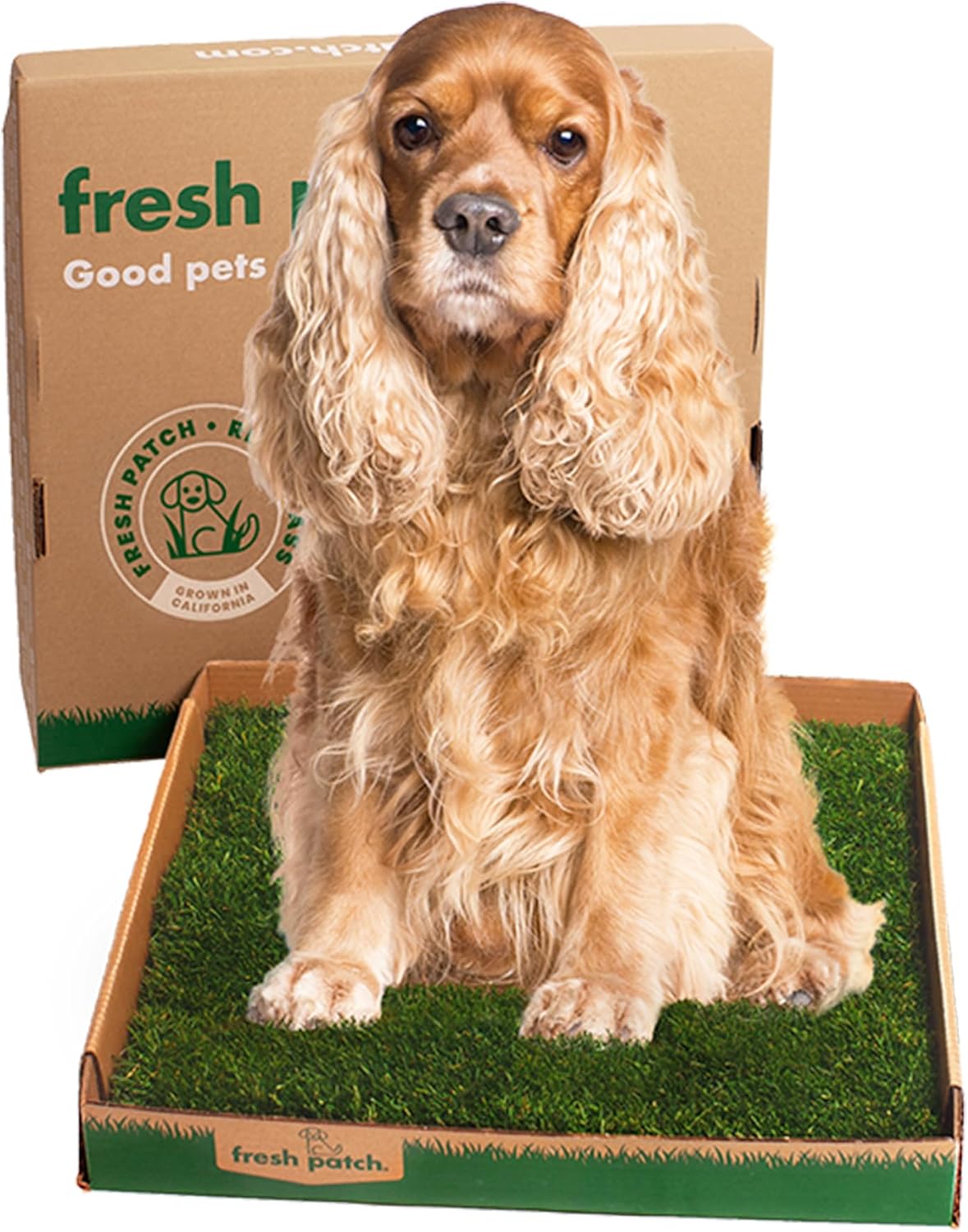
Piddle Patch Indoor Dog Toilet
We may earn a commission from purchases (at no extra cost to you)
3. Very Frequent Trips Outside
The purist approach: just go outside every hour, even if it means multiple trips down three flights of stairs.
Reality check: This is exhausting and not always practical, especially overnight. Do what works for your situation. A well-adjusted, happy dog is more important than following someone else’s rigid rules.
How Long Does It Actually Take?
The question everyone asks, and the answer nobody wants to hear: It depends.
General timeline:
- Fast learners: 4-8 weeks to be mostly reliable
- Average: 3-4 months to be consistently house-trained
- Slower learners: 4-6 months (or longer, no judgement)
- Fully mature bladder control: 6-8 months
- Rare accidents even when trained: Can happen for years (usually our fault for being late)
Factors that affect timeline:
- Individual dog personality (stubborn vs. eager to please)
- Your consistency with the schedule
- Whether you’re home full-time or working (crate training helps with this)
- Previous living situation (dogs from breeders who kept them clean usually train faster)
- Age when you start (8-12 weeks is optimal)
- Health issues
Buster: 1 week for basic concept, 4 weeks for reliable, 8 weeks for complete confidence. He’s a swot.
Jago: 8 weeks for basic concept, 16 weeks for somewhat reliable, 20 weeks before we trusted him. He took the scenic route to understanding.
Both are now completely house-trained adults who can hold it all day if needed (though we don’t make them). Both signal when they need out. Both are excellent boys, even if one took significantly longer to get there.
The truth: You’ll have setbacks. You’ll have days where you think they’ve finally got it, then they’ll wee on the floor while looking you dead in the eye. Then suddenly, one day, you’ll realise it’s been two weeks without an accident. Then a month. Then you’ve got a house-trained dog and you can’t remember exactly when it happened.
Stick with it. It’s temporary. We promise.
Product Recommendations: What Actually Helps
After testing approximately 847 products (rough estimate), here’s what we actually use and recommend:
Enzyme Cleaner (Essential)
Dirtbusters Pet Pro Urine & Odour Destroyer
We may earn a commission from purchases (at no extra cost to you)
Training Pads (For Flats/Emergency Backup)
Pet's Hub Training Pads (50 Pack)
We may earn a commission from purchases (at no extra cost to you)
Training Treats
We use:
- Tiny pieces of cheese (high value, always works)
- Cooked chicken (cut small, Jago would do anything for chicken)
- Store-bought training treats (convenient, less messy)
What matters: Small size (pea-sized), delivered immediately, with genuine enthusiasm. Your Frenchie doesn’t care if it’s expensive organic free-range chicken or value-brand cheese. They care that you’re throwing a party every time they wee outside.
Frequently Asked Questions
Q: At what age should I start potty training my French Bulldog puppy?
Start immediately when you bring them home, usually 8-12 weeks old. They’re learning from day one whether you’re actively training or not—might as well make it intentional. The earlier you establish the routine, the easier it is. Buster started at 8 weeks and picked it up quickly. Jago started at 9 weeks and took his sweet time, but we started right away regardless.
Q: How long can a French Bulldog puppy hold their bladder?
General rule: age in months + 1 hour. So a 3-month-old puppy can hold it for about 4 hours maximum during the day. Overnight, they can often hold it slightly longer. By 6-8 months, most can comfortably manage 6-8 hours. That said, Jago defied all guidelines and had the bladder control of a sieve until 5 months. Every dog is different.
Q: Should I use puppy pads or go straight to outdoor training?
Depends on your situation. If you have easy garden access, skip the pads and go straight outside—one less transition to make. If you’re in a flat, third floor, no lift, and it’s February in Britain, use the pads for the first few weeks to avoid accidents and preserve your sanity. You can transition to outdoor-only later. The important bit is consistency, not whether pads are involved.
Q: Why does my French Bulldog keep having accidents in the same spot?
Because you didn’t use enzyme cleaner (sorry, but probably true). Regular cleaners don’t remove the scent markers that tell your dog “this is the wee spot.” Once we switched to proper enzyme cleaner and thoroughly treated repeat-accident areas, the behaviour stopped. Also, block access to that spot if possible while retraining.
Q: My Frenchie pees outside then comes in and pees again immediately. Why?
Three possible reasons: 1) They didn’t fully empty their bladder outside (got distracted—classic Frenchie move), 2) They’re marking territory indoors (different from regular weeing, usually small amounts), or 3) Medical issue like a UTI. For distraction: keep outdoor toilet trips boring and focused until they’ve finished. For marking: more training and supervision. For medical: vet visit.
Q: How do I stop my French Bulldog from peeing when excited?
Excitement peeing (usually when greeting people) is different from training issues—it’s often involuntary, especially in young puppies. Most grow out of it by 6-8 months as they gain better bladder control. Meanwhile: greet them calmly (no high-pitched voices), take them out immediately before visitors arrive, and don’t make a fuss if it happens. Jago did this until about 7 months, then suddenly stopped. Buster never did it because he’s far too dignified for such displays.
Final Thoughts: You’ve Got This
Potty training a French Bulldog is challenging, occasionally infuriating, and absolutely achievable.
You will have moments where you question every life choice that led you to standing in the rain at 6am begging a small dog to please, for the love of all that is holy, just wee so we can both go back inside and have breakfast.
You will clean up more accidents than you thought possible.
You will celebrate dog wee with more enthusiasm than you’ve celebrated most human achievements.
And then, one day, you’ll have a house-trained French Bulldog who signals when they need out, does their business efficiently, and makes you wonder what all the fuss was about.
Buster made it look easy (the smug git). Jago made it look impossible (the chaotic nightmare). Both got there. Your Frenchie will too.
Key takeaways: ✓ Start immediately with a consistent schedule ✓ Every hour outside for the first weeks (yes, really) ✓ Celebrate successes like they’ve won an Olympic medal ✓ Use enzyme cleaner for accidents (not optional) ✓ Accept that some dogs take longer than others ✓ Crate training helps enormously ✓ Don’t punish accidents—just clean and move on ✓ Stick with it even when it feels impossible
It’s temporary. The accidents will stop. The routine will become habit. And you’ll have a properly house-trained Frenchie who only occasionally pees in inconvenient places (usually because we forgot to let them out on time).
For more help, see our French Bulldog puppy checklist, separation anxiety guide, and training hub.
Now get out there and celebrate some dog wee. You’ve got this.
Last updated: February 2026. Every dog is different. Every house is different. Your Frenchie might learn faster than Jago (not difficult) or slower than Buster (also possible). Be patient. You’ll get there.